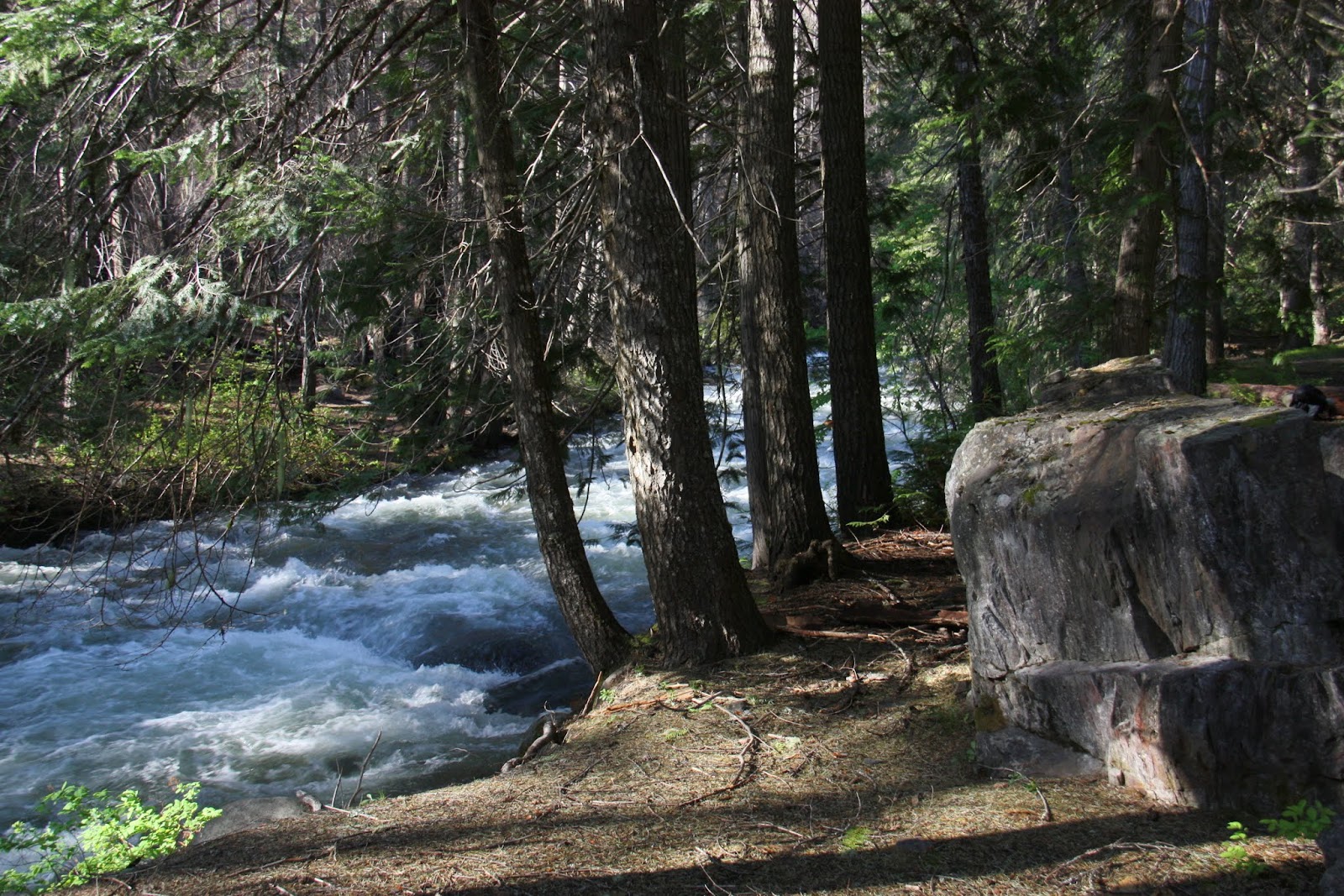
On Friday, June 11th, having stayed the night in Leavenworth, Washington, we crawled out of the back of the van and headed up Highway 2 to Chiwaukum Creek where we planned to hike for the day. After finding the trail, devouring some cold chicken for breakfast, and getting our gear together, we were on our way by 6:00 am.

We'd gotten the idea for this hike from our friend, Marti, who had recently made the same hike and described it in her blog http://meanderingwa.blogspot.com/2010/06/fun-weekend-fungus.html. We found the hike as pleasant as she described it and found what we came looking for and more, including one of our native orchids.

The day was sunny and warm and we soon shed our windbreakers, but since most of the hike was in the woods, the sun and heat were no bother at all. Indeed, the sun, when we were in it, felt good after weeks of rainy and cold weather on the other side of the mountains.
The trail follows the creek, really a mountain torrent, all the way, sometimes at the same level, at other times high above. The Indian name "Chiwaukum" means "many little streams running into one big one" and we soon found that to be true, but most of the other streams flowed in on the other side of the river and were inaccessible. We made periodic diversions into the woods along the river both to take pictures of the river and to search for whatever we could find. The hike was slow, therefore and we did around 10 miles in 7 hours, returning to the car at about 1:00 pm, and then on home.
We took a lot of wildflower pictures but also saw a lot of different fungi. The Coral Fungus and some morels we recognized but most we could not identify. The Coral Fungus is edible, but the examples we found were either past their prime or not yet fully emerged from the ground. The Morels we collected and took home and had them for our supper that evening fried in butter and served on toast with scrambled eggs.
The wildflowers were spectacular. The Queen's Cup Lilies (
Clintonia uniflora) were just opening in shady areas along with Hooker's Fairybells (
Disporum hookeri), the Large False Solomon's Seal (
Maianthemum racemosum), the Stream Violet (
Viola glabella) and the Trumpet Lungwort (
Mertensia longiflora). The Cliff Paintbrush (
Castilleja rupicola) was in bloom in the sunnier areas.

One highlight was
Lewisia tweedyi, the Mountain Rose, which seemed to be blooming everywhere along the trail, especially on rocky outcrops. This relative of the Bitterroot (
Lewisia rediviva), certainly vies with that species for the title of Washington's most beautiful flower, though I am content to enjoy them both without trying to decide between them, letting others do the arguing and deciding which is the best.

At higher altitudes in very shady moist areas we found the
Long-tailed Ginger (
Asarum caudatum), one of the flowers we had hoped to see on this hike. These are probably overlooked by most hikers, since the leaves look a little like the leaves of the Stream Violet, though the edges of the leaves have smoother edges and are shinier, and since the flowers are under leaves at ground level. Both because of the heavy shade and the location of the flowers, these were not the easiest to photograph. This delicate plant has bright green, shiny leaves, two on each plant coming from a rhizome that lies on the ground with the flower spikes starting at the base of the leaf stems and the flower lying on the ground, its dark color making it even more difficult to see and photograph.
On the return trip the sun was at its height and the butterflies were gathering at moister areas in the sunshine. We managed to get pictures of two of them, which I've tentatively identified as the Northern Blue (
Plebejus idas) and the Western Pine Elfin (
Callophrys eryphon). There were several others but they were too active for pictures.
Just before we returned to the car we made one more foray into the woods looking for morels. We found no more morels but did find some Western Fairy Slippers in bloom, as well as some Coralroots which were still a long way from blooming. We spent nearly another hour photographing and enjoying them and looking for more of them in the rather dense woods where we had found them.


Sated with all we had seen and enjoyed, relaxed and a bit tired we made the three hour drive home where we enjoyed a simple supper of morels and eggs and an early bedtime.
This is a hike we would recommend. It is easy, with plenty of interest along the way. It is especially to be recommended, however, at this time of the year for the opportunity to see Lewisia tweedyi in bloom.