Showing posts with label yellow lady's slipper. Show all posts

Monday, July 12, 2010

Backpacking in the Canadian Rockies (1)

Day One - Monday, July 5, 2010


Left our son-in-law and daughter's home in Edmonton at 2:00 am for the five hour drive west to Mount Robson Provincial Park.  Forgot that British Columbia is in the Pacific Time Zone and so arrived at the park headquarters at 6:00 am with two hours before we could check in, confirm our reservations and get our backcountry camping permits.

On the way saw several moose feeding, but too far away to get a decent picture, and a number of deer and elk.  I stopped to get pictures of two bull elk along a small lake in Jasper National Park and they plunged into the lake and began to swim across.  That was a picture I very much wanted, but it was still quite dark and the pictures turned out a bit grainy.


We were hiking the Berg Lake Trail, a very popular trail, and so had made reservations several months earlier, a good thing, since the backcountry campgrounds, especially the campground at Berg Lake, were quite full most of the time we were there.

After checking in and watching the obligatory 15 minute video on hiking and camping in the backcountry we drove the short distance to the trailhead and were on the trail by 8:30, crossing a footbridge across the Robson River and following the river north.


The weather had not been very good the previous week and we had watched the weather reports carefully.  We'd had fairly heavy rain while driving and there was still light rain as we started our hike, but the weather quickly improved and we had beautiful weather the rest of the day and the rest of the week.

Red Columbine (Aquilegia formosa)

Had to make only 11 kilometers to our first camp at Whitehorn, but that took us six hours since we stopped often to take pictures, especially of the wildflowers that were growing everywhere along the trail.  This usually involved taking off our packs and putting them on again, a rather laborious chore.  Landscape pictures were more easily taken.


Red, White and Blue for the 4th of July

Soon saw several native orchids, Listera cordata var. cordata, the Heart-leaved Twayblade and Platanthera huronensis, the Green Bog Orchis, the latter growing in every boggy or wet area along the trail, and its tall, bright green spikes very visible.


Listera cordata is a tiny plant only a few inches tall and was usually growing among other plants in shady well-drained areas.  As its name suggests, the two leaves are heart-shaped and are opposite each other a little above the ground.  This plant we found growing at all elevations up to our final camp at Berg Lake.

The first four kilometers of trail to Kinney Lake are much used by day hikers and bikers and are very easy hiking.  This gave us the chance to adjust our packs and get into the rhythm of hiking, and pictures of the Robson River which we were following, gave us some quick "breathers."


Arriving at Kinney Lake the weather was still cloudy, though the rain had stopped, and the trail, now through the woods and somewhat more difficult, gave us some wonderful views of the lake and of the mountains in the distance.


In the woods around the lake we began to see plants of Platanthera obtusata, the Blunt-leaved Rein Orchis.  We had seen this plant the previous year but then only a couple plants in flower.  Now it was everywhere along the trail and we would continue to see it nearly all the way to Berg Lake.


This plant was easily recognizable by the unique shape of its flowers and the rather long single leaf at the base of the plant.  Also saw three or four plants of the much larger and very elegant Platanthera orbiculata, the Pad-leaved Orchis.  They were near blooming but not a single flower was open, a huge disappointment.  Also saw a lot of the Lesser Rattlesnake Orchis, Goodyera repens, but none of these were in bloom either.

At the north end of the lake we had hoped to see again the Yellow Lady's Slipper (Cypripedium parviflorum) and the Sparrow's-egg Lady's Slipper (Cypripedium passerinum), but were disappointed to find that these were all finished - not a flower to be found.  Though we were hiking at nearly the same time as last year we saw everywhere that spring had come much earlier this year and that everything was further along.


Stopped at the Kinney Lake campground for lunch, having made about seven kilometers in four hours, nothing to brag about.  Each had an MRE for lunch, very convenient since it doesn't involve heating water and not too bad as far as hiking food goes.  Refilled our waterbottles and went on, now under better skies and in much warmer temps.


After hiking across the flood-plain north of the lake where we had found Yellow Lady's Slippers a year ago but none in bloom now, we started up Whitehorn Hill and along the last few kilometers to our first camp.  Saw a huge porcupine but were unable to get pictures.


Arrived at Whitehorn at about 2:00 pm, set up camp, soaked our feet in the river, and pumped a container of water with the purifier, one of my least favorite camp chores.  The camp at Whitehorn is in a beautiful basin along the river, and the campsites in the trees.


Finished setting up camp we took our cameras and headed north from camp toward White Falls.  Were delighted to find Yellow Lady's Slippers blooming in the woods and along the trail north of camp, and the Small Round-leaf Orchis (Amerorchis rotundifolia) as well and one tiny flower of the Sparrow's-egg Lady's Slipper.


The Yellow Lady's Slipper was interesting in its variable colors.  The pouches varied from a deep to pale yellow, but sepals and petals were even more variable, ranging from green to a rich mahogany color.


Amerorchis rotundifolia is an interesting plant, most closely related to the European genus, Orchis, and with no other close relatives in North America.  It is a small plant, about five inches tall, with delightful flowers that look like little pink-spotted angels.


At the falls, a beautiful cascade of four different waterfalls that are only partly visible from the trail, we climbed a loose and steep talus slope to get a better view and some time exposures of the falls.  Perched precariously on the slope, we got our pictures, but were relieved to be down at the bottom of the slope again.


By the time we finished photographing the orchids and the falls it was nearly 6:00 and we wandered back to camp where we had our evening meal of freeze-dried beef stew, teriyaki chicken and tea.  Afterward chatted for a while with some of the other campers and then headed to the tent where we read for a while (I started Bill Bryson's A Walk in the Woods) and finally went to sleep at about 8:00.


Note: The third, tenth and last pictures were taken by my wife.

Thursday, July 1, 2010

British Columbia and Alberta, 2010

Monday, Tuesday and Wednesday, June 28-30

Platanthera dilatata var. albiflora

Left Lynden Monday night at around 11:00 after starting and coming back for things we had forgotten including passports. This is very unlike me (my wife is different) since I usually have everything organized days ahead of time (is that obsessive or what?).

We followed the Trans-Canada Highway to Kamloops and then the Yellowhead Highway north from Kamloops. Drove until about 3:00 am, switching drivers once, when we found a rest area not far north of the North Thompson Provincial Park, where we slept for a couple of hours, waking about 5:00 am around dawn.


Began to see wildflowers including native orchids along the roadsides and stopped numerous times to take photos, not arriving in the area of Tete Jaune Cache, our first destination, about 10:30 am.

Yellow Rattle, Rhinanthus minor

Some of the wildflowers we photographed were the Pink Wintergreen, Pyrola asarifolia, the Columbia Lily, Lilium columbianum, which seemed to be growing everywhere, the Red Columbine, Aquilegia formosa, the Cow Parsnip, Heracleum maximum, and the Orange Hawkweek, Hieraceum aurantiacum.


But we were looking for native orchids and we found them, just as we had on a previous trip. Growing everywhere along the highway, especially on the wet banks and in the ditches were two varieties of Platanthera dilatata. We found both variety albiflora, the Bog Candle, and variety dilatata, the Tall White Northern Bog Orchis.


The three varieties of this plant are very interesting. They are distinguished mainly by the length of the spur, variety albiflora having a very short spur that is shorter than the lip, variety dilatata having a spur about the same length as the lip and variety leucostachys (which we did not see) having a spur much longer than the lip.

This would seem a very minor thing, except it means that each of these varieties probably has a different pollinator. We noticed, too, that they grow in different locations. We at least never found the two varieties we saw growing in the same location.

We also found three other Platanteras growing in and among the white P. dilatata: P. huronensis, the Green Bog Orchis, P. aquilonis, the Northern Green Bog Orchis, distinguished by a yellowish lip and a thickened spur, and P. stricta, distinguished by a narrow, squared-off lip and a “scrotiform” spur.

These were extremely hard to distinguish, even with a good key, however, since the variations between the different species are never clearly distinguishable, and as Brown says, “Throughout much of the Pacific Northwest the several species of green-flowered Platanthera tend to intergrade.”  The picture below and to the right is of a plant that is probably Platanthera huronensis, but the flower color is more like that of P. aquilonis.


In the area of Tete Jaune Cache we had hoped to see the Large Yellow Lady’s Slipper (Cypripedium parviflorum var. pubescens) and followed some back roads in the area to a place near the river where we had previously seen it in abundance. It was, however, almost completely finished, with only a few flowers still in bloom in that area and so we were able to get some decent photos of these very beautiful flowers.


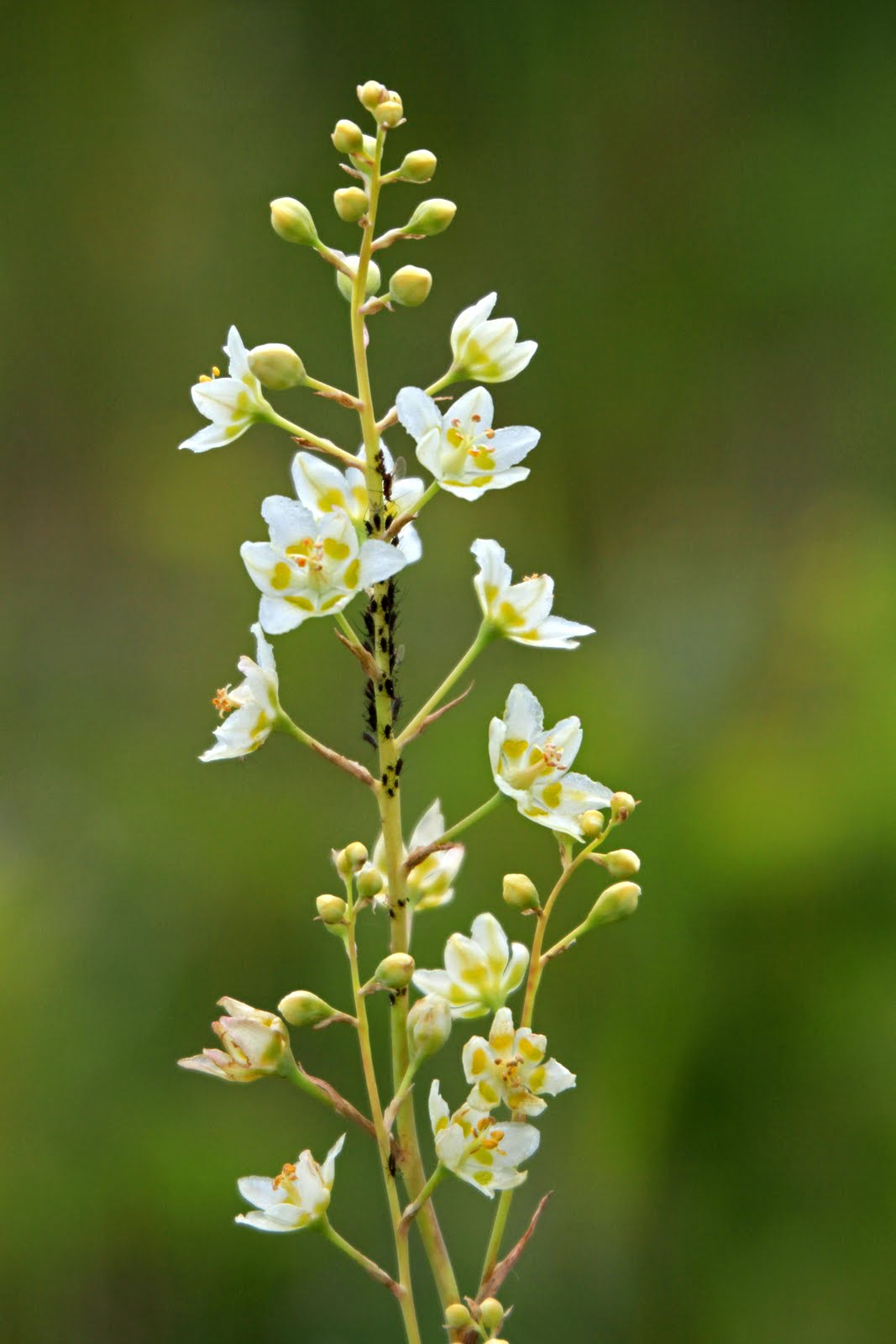
We also took pictures of the river, of the Death Camas (Zigadenus elegans), which was growing in the drier areas and which is obviously not death to aphids, of the green-flowered Platanthera which I could not identify (shown above), and of a butterfly and hoverfly visiting the same flower.


Finishing there we traveled northwest to the town of Dunster where we hoped to find the Mountain Lady’s Slipper (Cypripedium montanum), and find it we did, growing by the hundreds along a steep slope in the dappled shade of deciduous trees and underbrush.


These were covered with what appeared to be the "fluff" of Cottonwood trees, as is evident from most of the pictures. This did not distract, however, from the elegance of these beautiful flowers.


On some of the flowers tiny beetles were crawling all over the area where the pollen is found. Whether these are the actual pollinators of these plants I do not know, but they can be seen on the lip and around the staminodes.


After taking numerous photos there and suffering the stares of the passersby, we went on to the river, a little further down the road, and were delighted to find numerous swallowtails, the Canadian Tiger Swallowtail, if I am not mistaken, resting in the wet mud on the riverbank and in the plants nearby.  They were so passive that we could get within inches of them without them flying away, though when my wife's shadow fell on them they all flew off.  They were perched on top of each other and with their wings interlaced.


We traveled back from Dunster to the Mount Robson Visitors’ Center where we asked some questions about the next week’s backpacking trip, taking pictures along the way. There we had to decide between doing some day-hiking along the Berg Lake Trail or going on to Jasper National Park and doing some sightseeing there.

Since we were both tired from lack of sleep and crawling around on the ground after wildflowers, and since we would be hiking the Berg Lake trail the following Monday, we chose the latter option and headed for Jasper, a decision that proved the right one. Along the road to Jasper we saw a mother black bear and her older cub and stopped with a number of others to take pictures.


Arriving in Jasper we headed up the Maligne Lake Road where we saw some elk feeding, mainly cows, though on the way back we saw a huge bull elk with his rack still in velvet.


Not far up the road we stopped and visited the Maligne Canyon and falls, which, though a popular tourist destination, is nevertheless quite impressive. Both the narrow canyon which the water has carved and the rush of water far below unique, though the narrowest parts of the canyon are so deep and dark that they are almost impossible to photograph.  There is quite a bit of hiking one can do along the river, but we were too tired to do more than the short tourist circuit.


On the road to Maligne Lake we saw a beautiful lily, the Wood Lily, Lilium philadelphicum. This lily grows only to about a foot tall, but is exquisitely beautiful. A stiff breeze had kicked up and these proved very difficult to photograph.


We also found there a blue Columbine, Aquilegia brevistyla, and the White-leaved Wintergreen, Pyrola picta. My wife discovered the work of leaf miners nearby and we spent considerable time photographing the beautiful patterns these make.


Further up the road we found one solitary clump of the Yellow Lady’s Slippers (Cyp. parviflorum var. pubescens), which made up for the lack of flowers at the previous location. These were in full late evening sun and very difficult to photograph as a result.


In the end we spent too much time photographing wildflowers and did not make it all the way to Maligne Lake. We took pictures of Medicine Lake on the way and of a yellow Columbine there (Aquilegia flavescens, the Golden Columbine).


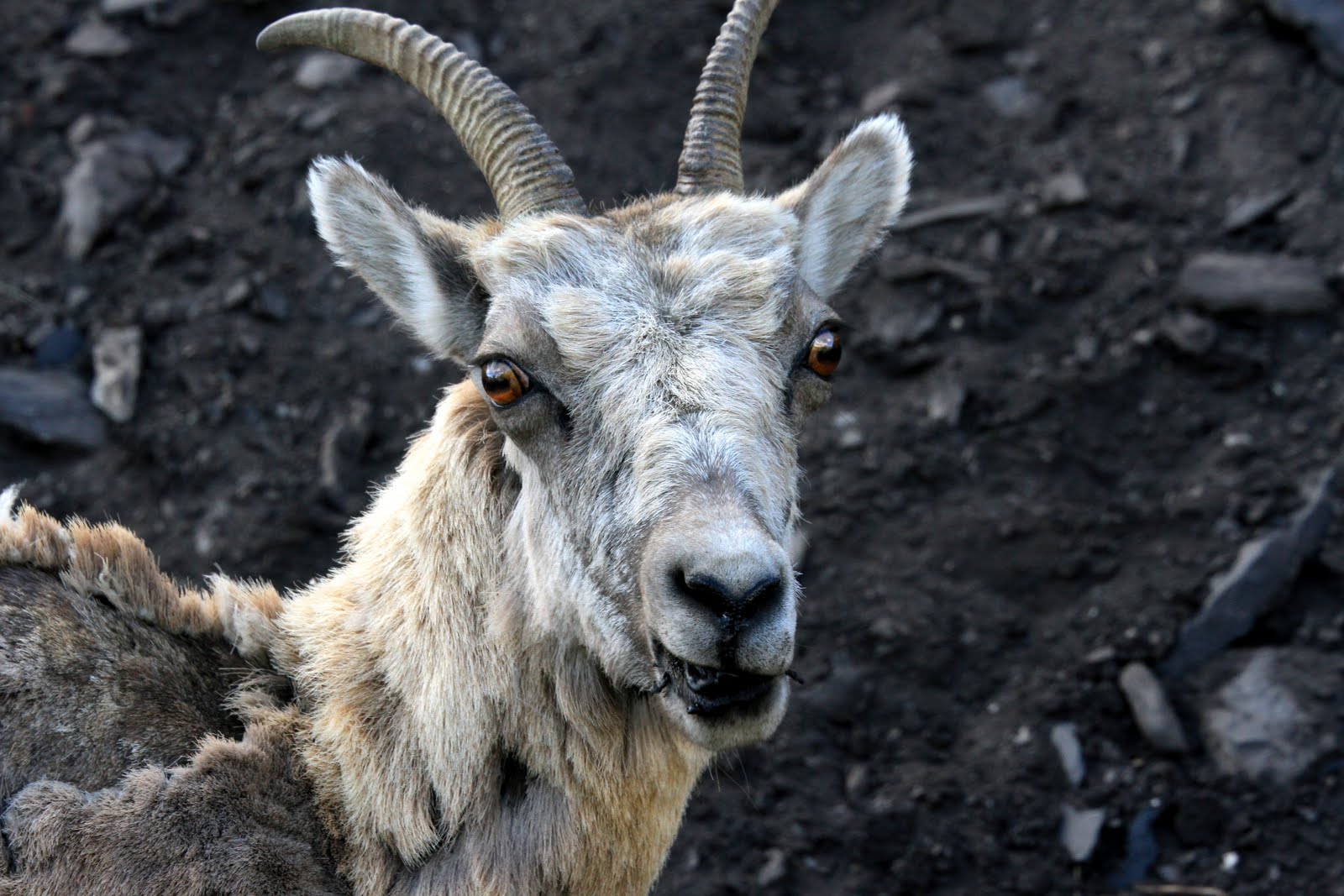
Turning back we picked up the Yellowhead Highway once again and traveling east saw some rather ratty looking Mountain Goats along the road and stopped to take pictures of Jasper Lake and the mountains in the evening sun.


Surfeited with all we had seen and completely shattered we stopped in the first town we came to, Hinton, Alberta. After getting some supper there, we slept the night in the van before going on to our son-in-law and daughter in Devon, a suburb of Edmonton, where we were delighted to see our new granddaughter Kailyn, born June 7th, whom we both agreed is the most beautiful baby we’ve ever seen.