
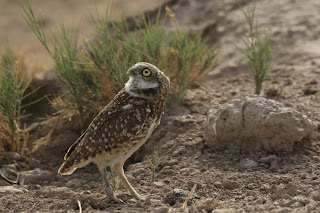
After leaving Anza-Borrego Desert State Park we headed for the Salton Sea. We had never been there and discovered that apart from the Sonny Bono Wildlife Refuge there wasn't much to see. That was our first destination in any case and our visit there, though we missed the main bird migration, the refuge was still wonderful and we saw many new birds including the Burrowing Owl shown above.
There are two parts to the refuge, both on the southern end of the Salton Sea. We drove first around the shallow ponds that are part of the more western area and saw a lot of waterbirds there. Note: some of my identifications are probably wrong.
American Avocet


Short-billed Dowitcher


Snowy Egret


Great Blue Heron


We then went to the visitors' center, watched the birds there (and a large lizard and had our lunch. It was at the visitors' center that we saw a pair of burrowing owls, one of which is shown at the head of this post. They were a first for us and well worth the whole trip to the refuge.
Boat-tailed Grackle

White-crowned Sparrow


Burrowing Owl


From the visitors' center we followed the short trail to Rock Hill, a small inactive volcano which is the only place that is not level. There, too, we watched the water birds and raptors.


Western Kingbird

Marsh Hawk

Marbled Goodwit

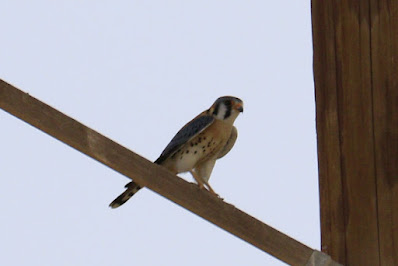
Kestrel
Finished at the refuge we went north along the east side of the sea, stopping in a few places for photos but finding the old resorts abandoned and the sea a rather hot and unpleasant place. The following quote is from the website of the Federal Fish and Wildlife Department:
"The Sonny Bono Salton Sea National Wildlife Refuge is located in California’s Imperial Valley, 40 miles north of the Mexican border at the southern end of the Salton Sea... Because of its southern latitude, elevation of 227 feet below sea level, and location in the Sonoran Desert, the refuge sees some of the hottest temperatures in the nation. Daily temperatures from May to October exceed 100°F with temperatures of 116°-120°F recorded yearly. The Salton Sea Authority has measured the current salinity of the sea to be 60 PPT. By comparison, the ocean water is approximately 35 PPT. Despite the harsh environmental conditions, the Salton Sea supports one of the most diverse avian compositions in the United States as well as a host of endangered and other wildlife species... The Salton Sea is the most recent form of Lake Cahuilla, an ancient lake which has cyclically formed and dried over the centuries due to natural flooding from the Colorado River. The current Salton Sea was formed when Colorado River floodwater breached an irrigation canal being constructed in the Imperial Valley in 1905 and flowed into the Salton Sink. For decades, the Sea continued to receive sufficient quantities of water from irrigation runoff and the New and Alamo rivers, providing fresher water to the Salton Sea... But over time, the evaporation of water in the hot desert, combined with fallowing of farm fields to supply additional water to San Diego County and lack of outflow, has continued to decrease the size of the sea. This results in a highly saline body of water that is losing its ability to sustain fish and organisms essential for migrating birds that depend on it."
Bombay Beach


