Showing posts with label goat mountain. Show all posts

Tuesday, August 12, 2014

A Native Orchid Tour of Washington


One of the highlights of the summer was an opportunity to show off some of our native orchids.  Friends from Germany were planning an extended trip to the USA and wanted an orchid tour of Washington as part of their trip, so all last winter we were making arrangements, they for the whole of their trip and I for the small part of their trip that involved me.  We agreed that we would spend three days together and I would show them as many of the native orchids as were in bloom.  In the end that amounted to 17 different species and varieties, almost half of our native orchids.

I met them in the Columbia River Gorge where we began by hiking at Dog Mountain.
There we saw:

1.  Piperia transversa (Flat-spurred Piperia)
just beginning to bloom and a species we would see again at Deception Pass


2.  Cephalanthera austiniae (Phantom Orchid)
this was one they particularly wanted to see


3.  Goodyera oblongifolia (Giant Rattlesnake Orchis)
not yet in bloom


4.  Corallorhiza striata var. vreelandii (Vreeland's Striped Coralroot)
a few plants at the end of their bloom season


5.  Corallorhiza maculata var. maculata fma. aurea (Spotted Coralroot)
the rare yellow-stemmed form of this species


6.  Corallorhiza maculata var. maculata fma. rubra (Spotted Coralroot)
the more common red-stemmed form of the species


From Dog Mountain we traveled to Catherine Creek, also in the Columbia gorge.
We went there to see:

7.  Spiranthes porrifolia (Western Ladies'-tresses)
very rare in Washington and at the peak of its bloom season


Leaving the gorge we traveled to Brooks Memorial State Park near Goldendale,
and saw:

8.  Piperia unalascensis (Alaskan Piperia)
we were looking for the Mountain Lady's Slipper but found this instead


Traveling further north we visited two sites in Blewett Pass, south of Leavenworth.
We camped a night there and also found:

9.  Cypripedium montanum (Mountain Lady's Slipper)
hundreds of these


10.  Platanthera dilatata var. dilatata (Tall White Northern Bog Orchis)
just starting to bloom


From eastern Washington we moved closer to home and visited Deception Pass on Whidbey Island,
where we found:

11.  Piperia elegans (Elegant Piperia)
already in bloom, though usually quite a bit later


At another site on Whidbey Island we found another species,
this time:

12.  Corallorhiza maculata var. ozettensis (Ozette Coralroot)
this was only just hanging on but an abundance of Indian Pipes made up for their scarceness


The third and last day of our trip we visited Goat Mountain in the North Cascades.
There we found:

13.  Corallorhiza mertensiana (Western Coralroot)
in bloom so late only at these higher altitudes


14.  Listera cordata var. nephrophylla (Western Heart-leaved Twayblade)
not a lot of them but enough to make a fair show

15.  Corallorhiza maculata var. occidentalis fma. intermedia (Western Spotted Coralroot)
only a couple of plants of this early-blooming variety


16.  Corallorhiza trifida (Early Coralroot)
this one familiar to our friends since it also grows in Europe


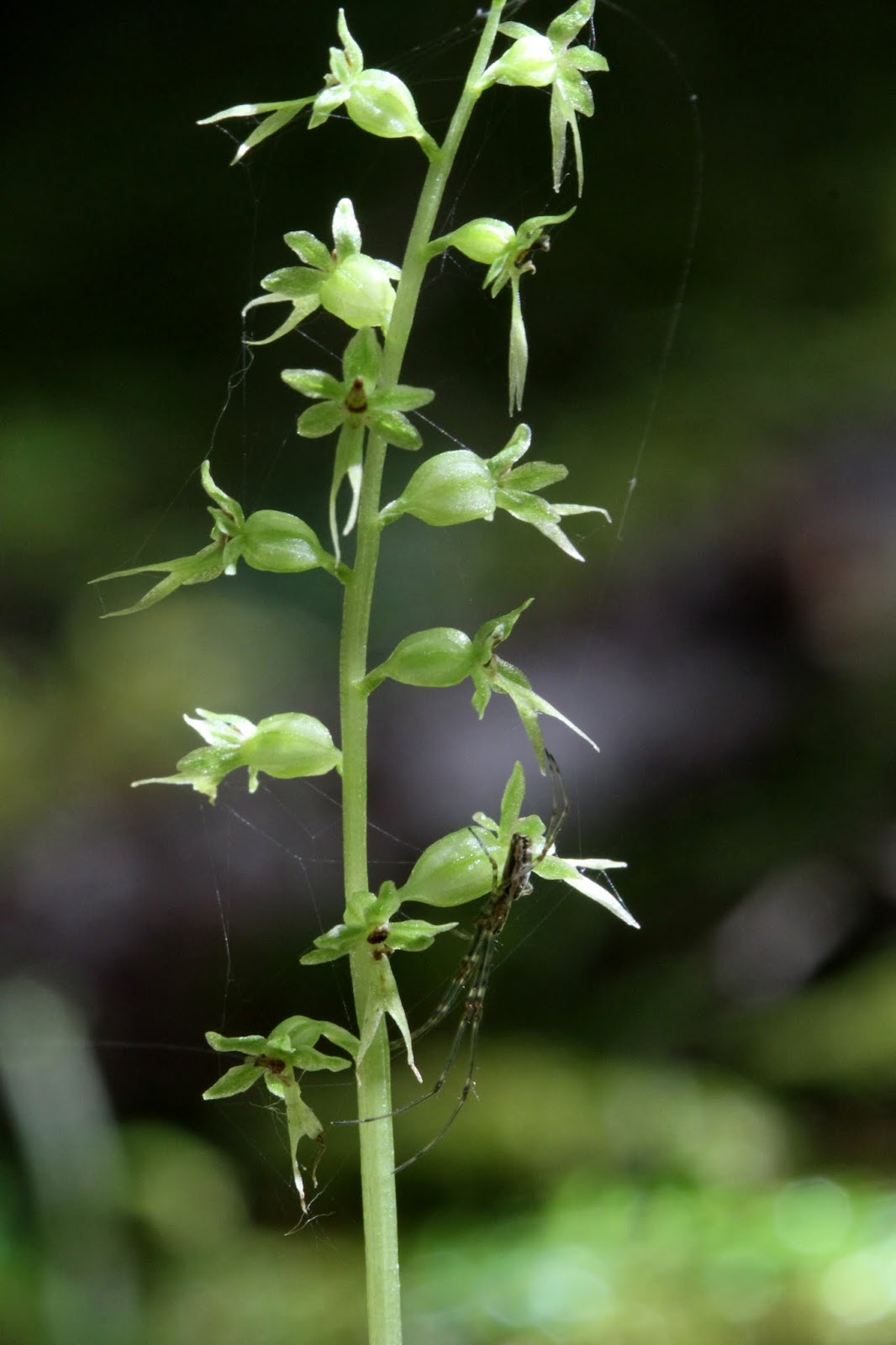
17.  Listera banksiana (Northwestern Twayblade)
after searching hard I finally found a couple of plants in bloom


We very much enjoy orchid hunting but it is even more exciting to be able to show someone else.
Martin has a blog of his own at which you can see some of the native orchids
of Germany and Europe, and some of these orchids as well.
http://www.lichtschnapper.de/blog/

Wednesday, October 12, 2011

Three Orchids on the Goat Mountain Trail


I am way behind in blog posts, but I guess that gives me something to do over the winter months when there's not much hiking to be done.  This post, then, goes back to the beginning of August, August 5th, to be exact.  That afternoon for a few hours a friend and I went to do some hiking on the Goat Mountain trail in Mount Baker-Snoqualmie National Forest.

We did not go far enough on the trail - did not have enough time - to get out of the trees and into areas where we could view and photograph the surrounding mountains.  We did see some interesting plants and wildflowers, however, and that is going to be the main subject of this post, though the light was not very good and photography was difficult.


The plants we saw, all under rather heavy forest cover, were primarily saprophytes.  That name is no longer in common use as a result of further research on these plants, but I cannot remember what they are now called. These are plants without chlorophyll, leafless, and living off decayed matter in the soil through a sympiotic relationship with soil fungi.


One of these plants that seemed to be everywhere was Monotropa uniflora, Indian Pipes, also known as the Ghost Plant or Corpse Plant for obvious reasons.  We also saw two saprophytic orchids, both Coralroots, though one of them was finished blooming.  They were the Spotted Coralroot, Corallorhiza maculata var. maculata and the Early Coralroot, Corallorhiza trifida.


The Early Coralroot was finished blooming, but there were many nice clumps of them that we will have to go back and see next year when they are still blooming.  We did see one other orchid in bloom that is not a saprophyte, however, the everywhere present Listera banksiana, the Northern Twayblade.  I did not get the best pictures of it, so this will have to do.


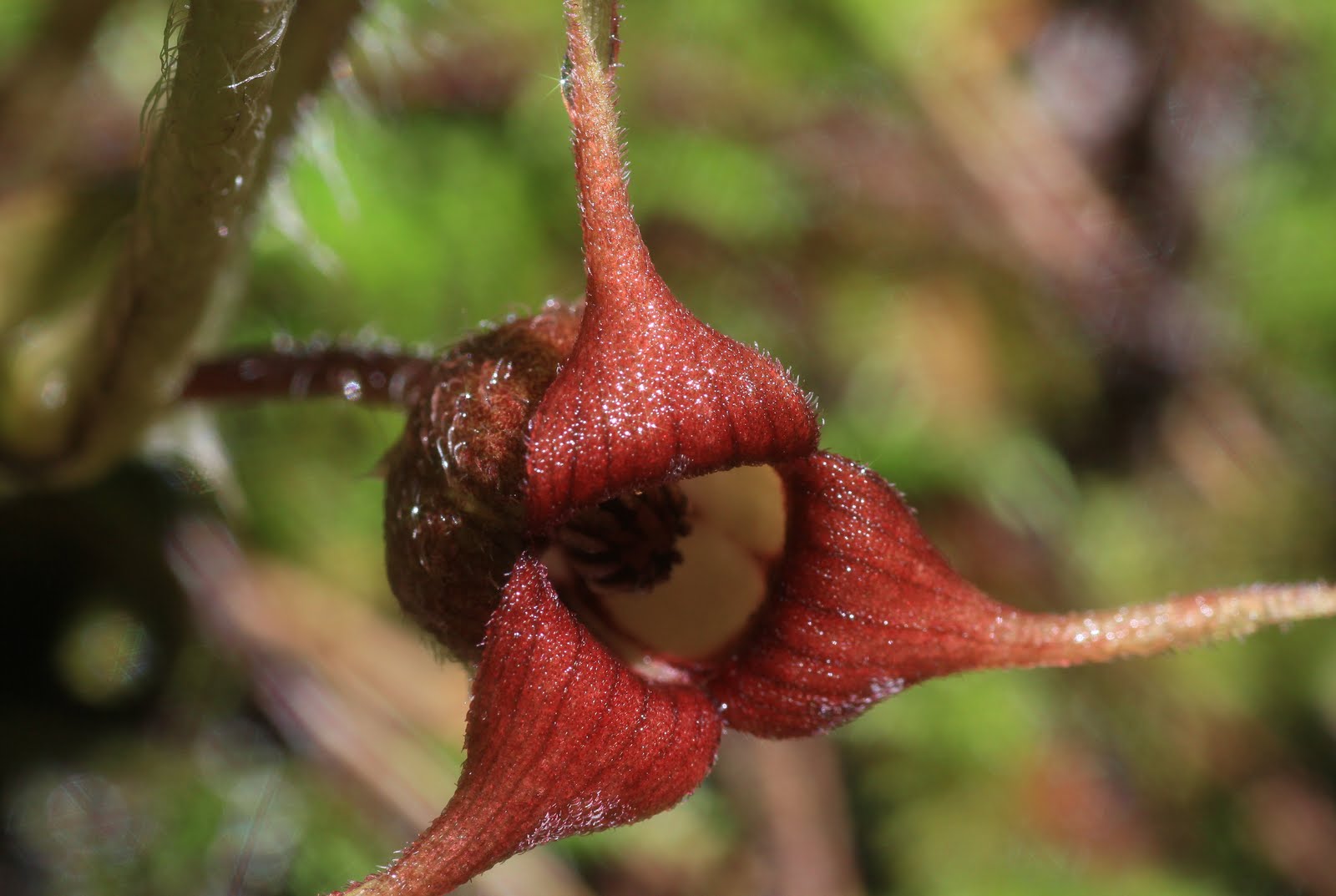
One other plant, blooming everywhere, especially in damper areas, was the Long-tailed Ginger, Asarum caudatum.  Unless you are looking for it or know what you are seeing, its flowers are not usually noticed since they lie on the ground under the leaves.  Seeing them is always a treat since their color, long tails and unique shape are unmatched.

Saturday, June 19, 2010

Goat Mountain

Friday, to celebrate our wedding anniversary, my wife and I hiked Goat Mountain in the Mount Baker Wilderness.  We were not able to leave home until about 9:30 am and were not on the trail until about 11:00 am, so had just a short day hike.

We stopped at the Ranger Station in Glacier to ask about the trail conditions and about native orchids.  We were informed that most of the trails were still snow covered at 4500 feet and above, but that the Goat Mountain Trail was open for several miles and that someone had reported seeing Lady's Slippers on the trail, so off we went.


We made one stop on the way to the trailhead to take pictures of Mount Shuksan and the Nooksack River.  There was no one else at the trailhead and we spent a while there taking pictures of some of the dew covered plants, of an unidentified beetle, and of a small butterfly, probably a Silvery Blue (Glaucopsyche lygdamus).


We found the trail to be all in the woods and quite steep with a lot of switchbacks, but we were not in a hurry and took our time, doing the three miles of open trail in about four hours (45 minutes back), stopping often for pictures and to explore the woods along the trail.


After the second switchback we began to see Fairy Slippers (Calypso bulbosa var. occidentalis) along the trail as well as a number of Coralroots, both Merten's (Corallorhiza mertensiana) and Spotted (Corallorhiza maculata), neither of which were close to blooming.


While taking pictures of some of the Fairy Slippers we also found some unusual fungi and lichens, one fungus like a black cup partially buried in the ground and the lichens with interesting fruiting bodies held above the flat "leaves."


There were a lot of waterfalls and streams as a result of snow melt at higher elevations and we made a long stop to take some time exposures of one of them.  When my wife was finished she pulled out a book and sat on the trail to read while I finished taking pictures.


There we saw the only other hikers of the day, two girls who were making much better time than we were.  After they passed us my wife spotted a mouse, possibly a Deer Mouse, which we could not identify with certainty and we watched him (her?) going about its business totally unconcerned with us.


After the mouse we came to a long stretch of trail that was relatively flat and it was there that we found the day's treasure, numerous spikes of a tiny Corallroot that I had never seen before, Corallorhiza trifida.  This tiny plant was growing in a rather damp area and we had to crawl around to get pictures.


As we gained altitude we continued to see these along the trail for a while along with Trilliums, which were finished flowering lower down the trail, and many other wildflowers also, including the wild ginger, Asarum caudatum.  This, when any part is crushed, has a strong ginger odor.


We continued up the trail until about 3:00, having hiked about three miles, at which time we had to turn back.  Though keeping our eyes opened for other treasures and for morels, of which we found a few, we were back at the car in less than 45 minutes and home before 5:00.