When we visited the floating bog on Summer Lake in Skagit County a few weeks ago (
http://ronaldhanko-orchidhunter.blogspot.com/2010/10/little-bog-of-horrors-revisited.html), we had no intention of returning again this year. However, our good friend, Marti Anderson, expressed an interest in seeing the bog (you'll find her site here:
http://meanderingwa.blogspot.com/), and so we decided to go once more to show her this wonderful place, and as it turned out, picked a beautiful, sunny, autumn day.
This is the bog where someone has introduced a number of species of carnivorous plants, especially Pitcher Plants and Flytraps and where they have become established and flourished. The place is amazing and it was a lot of fun to show the place to Marti, who I think enjoyed the excursion but for the wet feet she got at the end with my wife's help.
We had agreed to meet at 10:30 am, but my wife and I arrived a bit early and decided to walk down to the north end of the bog to take a few pictures in the early morning light. We also looked once more for the Cobra Lilies that had been reported from that end of the lake, but did not find them. When we were finished taking pictures we walked back and found Marti waiting for us.
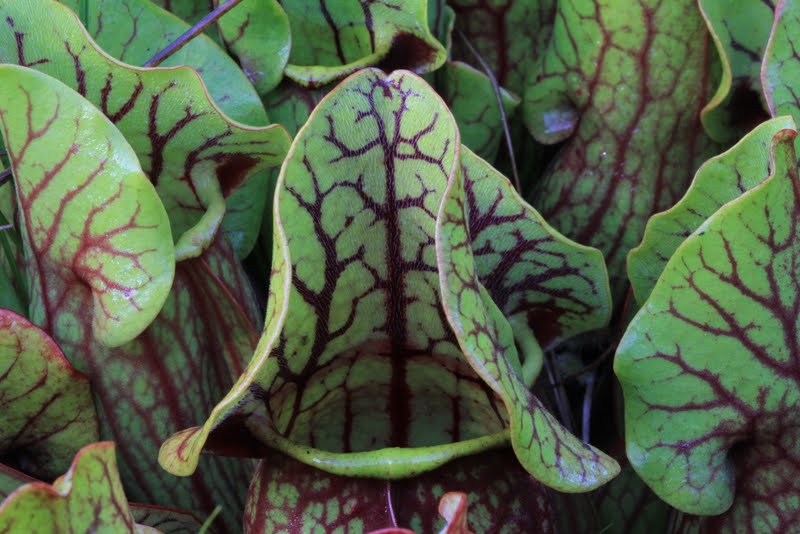
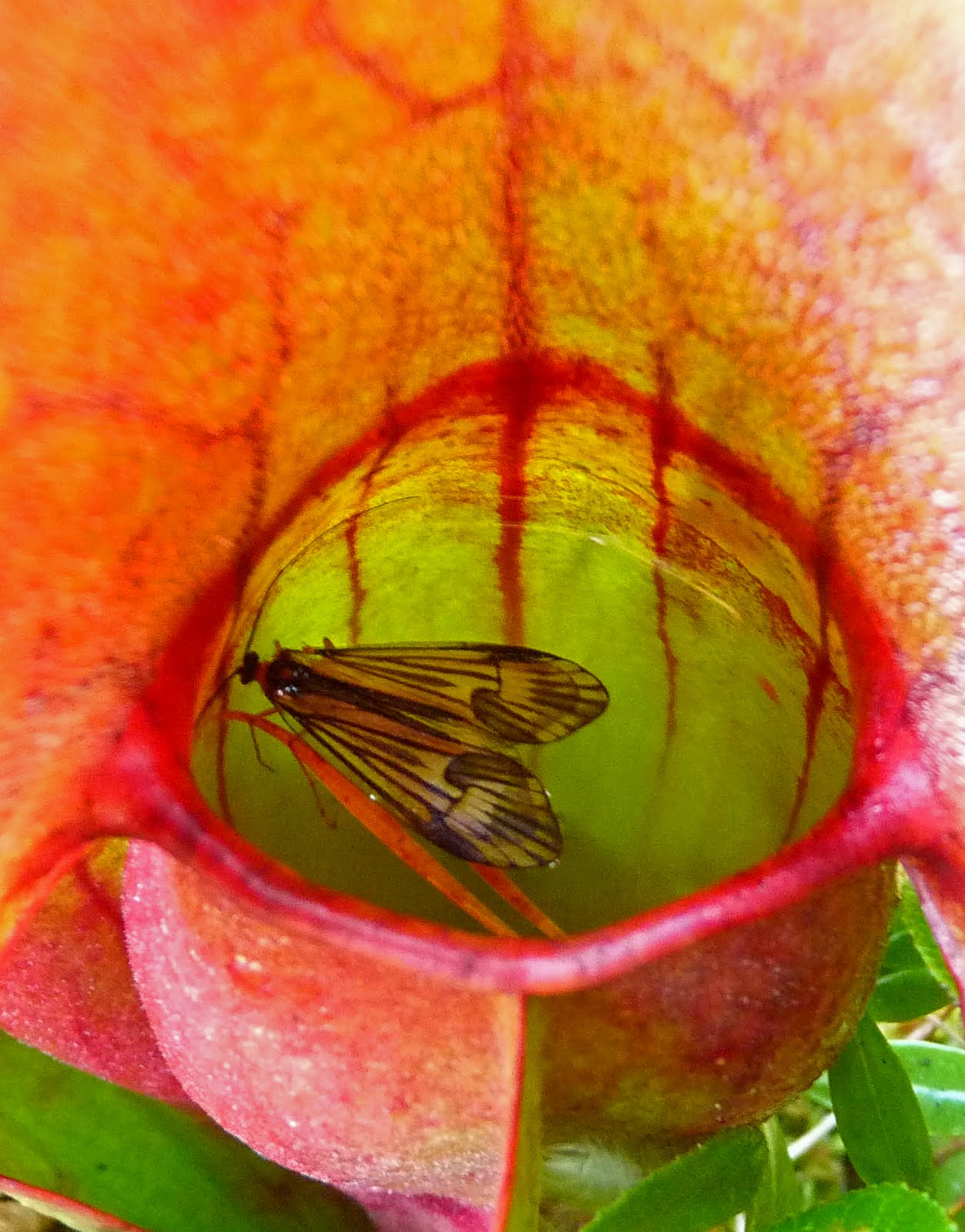
We negotiated the rather treacherous series of hummocks, logs and boards that got us out on to the floating mat of vegetation and immediately found several clumps of the Purple Pitcher Plant (
Sarracenia purpurea), one with a moth floating on the water in the pitcher. The moth was still struggling, but there was no doubt that it was destined to become a meal.
As we made our way around the lake we found numerous clumps of Yellow Pitcher Plants (
Sarracenia flava), growing mainly on the south end of the lake, and were able to photograph a spider lurking down in one of the tubes. It was fun to show Marti the place, but she was the one who found both the moth and the spider though my wife was the one who found and photographed the spider on its web.
We also spent a lot of time picking bog cranberries which we used to make scones, using a recipe from Marti. These grow on tiny stems close to the ground and while they are not overly abundant, nor easy to see, enough of them can be gathered to make a treat of some kind. One of the reasons they are difficult to spot is their reddish color, It blends in with the sphagnum moss which has also turned a red color at this time of the year.

Along with the carnivorous plants we inspected a floating island which we have seen in different locations around the lake. This time it was in an area where we could see it, though we did not dare get on it. I had been told that it was built by fishermen, but whoever made it put a great deal of work into it. It is also quite old since there are trees growing on it that must be more than twenty years old. I've included part of a satellite picture of the lake from Google maps which shows the island at the very bottom corner of the lake. It was further east (to the right when we saw it this time.
At one point Marti, standing at the edge of the floating mat, put her hiking pole down into the water to see how deep it was and though the pole was fully extended, was not able to touch bottom - not very encouraging when one can feel the floating mat moving underfoot and when one has to watch for holes in the mat of vegetation.
The Yellow Pitcher Plants are the most abundant and on the south end of the lake were everywhere in huge clumps. I even photographed some of them on the opposite shore far our of reach from where we were exploring. I was told that their seeds float and so spread to different locations. That certainly appears to be the case here.
There is considerable color variation in these plants. They range from green to bright yellow and from being very heavily veined in maroon to no veining at all. These were also in flower, their rather weird flowers resembling a daffodil.
On the southwest end of the lake we found a few of the White Pitcher Plant (
Sarracenia leucophylla) still untouched by frost or age, as well as several good-sized clumps of Venus' Flytraps. One clump of the latter was a dark red color, but we assumed this meant that it was dying. After getting more pictures we headed back around the lake.
The only only other thing we found in bloom was a lone stem of something whose flowers resembled the Fringed Grass of Parnassus but which had numerous flowers on the spike rather than single flowers like that species. Marti subsequently identified this as Buck-bean,
Menyanthes trifoliata.
We photographed some Cotton grass and some sedges as well along with the beautiful scenery and in all spent nearly four hours there. The place is incredible and no amount of time spent there can do justice to all there is to see.
My wife and I had worn old tennis shoes so that we did not have to worry about getting wet feet. Marti, however, had worn boots and had kept her feet dry, but as we were making our way back out of the bog slipped (with my wife's help) and ended up with wet feet anyway. Safely back on dry land, we changed into dry footwear and went our separate ways.
Note: nine of these pictures were taken by my wife, including the pictures of the floating island and of the moth and spider.