
Thereafter our travels slowed dramatically. The fifteen mile trip up Hurricane Ridge took us 4 hours with numerous stops for pictures and one brief hike. Most of the stops were for flower pictures, however, since the weather was cloudy early in the day though it cleared as the day progressed.

Sedum lanceolatum (taken by my wife)

Digitalis purpurea
We were on our usual lookout for native orchids and saw five of them on our way up the ridge, Piperia unalascensis, the Alaskan Piperia, Platanthera stricta, the Slender Bog Orchis, and two varieties of Platanthera dilatata, var. leuchostachys and var. dilata, the White Bog Orchis or Bog Candle, among them. The Piperia was nearly finished blooming and I did not bother with pictures.

Platanthera dilatata var. dilatata
Very interesting were the areas where we found Platanthera dilatata var. leucostachys growing side by side with the natural hybrid of that plant and Platanthera stricta. This hybrid is named Platanthera x estesii and has the flower shape of dilatata and the green color, though paler, of stricta..


The Parents: Platanthera dilatata var. leucostachys and Platanthera stricta

The Hybrid: Platanthera x estesii
The hybrid is often found alone with neither of the parents nearby. We were a bit confused, however, since our sources listed this as a hybrid of stricta and dilatata var. albiflora which we did not see anywhere along the road that day in or out of bloom, while it was flowering with and alongside var. leucostachys.

Some of the other floral highlights of our trip up the ridge were the Elephant's Head Lousewort, Pedicularis groenlandica (named for it's obvious resemblance to the head of that animal and blooming in very wet areas), the Nodding Onion, Allium cernuum, growing in very dry areas,and the Avalanche Lily, Erythronium montanum, one of our favorite wildflowers.

Pedicularis groenlandica

Allium cernuum

Erythronium montanum
Other flowers were the Olympic Delphinium, Delphinium glareosum, a pink form of the Common Yarrow, Achillea millefolium, the Cascades Penstemon, Penstemon serrulatus, and the Cascades Wallflower, Erysimum arenicola.


Delphinium glareosum

Achillea millefolium

Erysimum arenicola

Penstemon serrulatus
Often the flowers were growing together like a lovely garden and almost always with the Indian Paintbrush which were everywhere. I have trouble identifying them,however, and do not know if they were all the same species or if we saw different species


My wife took pictures of this spider and I managed to get a pictures of two butterflies one which was identified by our friend, Marti as the Clodius Parnassian, after its picture was posted and the other which I've tentatively identified (with Marti's help) as the Silvery Blue. I must get some kind of reference for butterflies in our area, since there are very few of them that I know or recognize.


Parnassius clodius

Glaucopsyche lygdamus (?)
We saw also the Common Butterwort, Pinguicula vulgaris, growing in abundance along the stream at the Klahane Ridge trailhead where we did our only hiking. Several of the Platantheras were growing there as well, along with the Seep-spring Monkeyflower.

Pinguicula vulgaris


At the visitor's center and parking lot we refilled our water bottles, took a few pictures of a friendly deer and proceeded on down the road that continues west for a short distance. We were looking at the end of the road for a dwarf form of Piperia unalascensis (forma olympica) that grows only in that location.


We had come looking for this plant a year ago, but had missed it in bloom. Now we found it and spent some time taking pictures and talking to a member of the Washington Native Plant Society who had also found it (unexpectedly for him) on the ridge.


We also found on the ridge a dwarf form of the Columbia Lily (Small-flowered Tiger Lily, Lilium columbianum), that was only six inches tall - the plant grows to six feet at lower elevations. These only ever had one flower. We also found numerous plants of the Olympic Onion, Allium crenulatum.


Having seen what we wanted there, we went back to parking lot at the visitor's center and took the gravel road that drops off the end of the parking lot and runs southeast for about eight miles, the road to Obstruction Point. This road is not visible from the parking lot and few visitors seem to know about it.

At the four mile point, often referred to as the Waterhole, we found a road grader blocking our way. Talking to the driver we discovered that he had just finished opening the road the rest of the way. He offered to move the grader, but warned us that there was a lot of snow further up and that the road was very wet from snow in places.

We went on anyway and were thankful we did. We saw Avalanche and Glacier Lilies (Erythronium grandiflorum) by the millions (and I am not exaggerating), along with many other early-blooming wildflowers, before we came to the end of the road which found not only very muddy in places, but also very rough.


Two flower that especially caught our attention were the Dwarf Lupine (Lupinus lepidus var. lobbii) and Alpine Phacelia (Phacelia sericea var. sericea). These were growing in alpine flower garden that included more flowers than we had time or energy to look up.


The sign at the end of the road really caught our attention. My wife wondered if anyone had been on the receiving end of the threat expressed! Certainly wouldn't be very pleasant. So, lest we be caught, we hurried back and then made our way down the Hurricane Ridge road.

In Port Angeles we went west and traveled another ways to Crescent Lake and to East Beach where we hoped to find two other orchids. One of the two we had seen the year before though it was almost finished blooming and the other we had found completely finished.
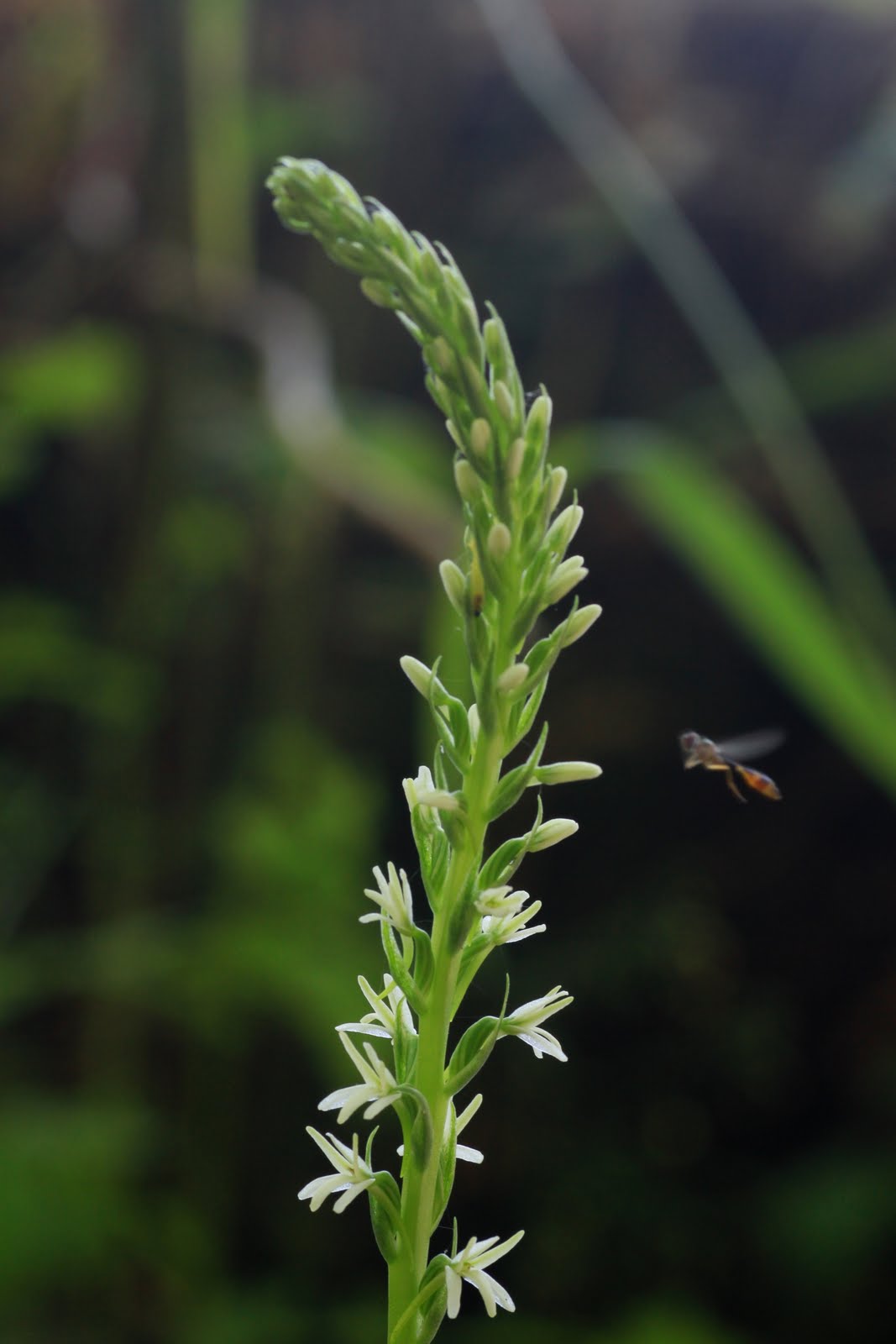
Piperia elegans
The star of the day was Epipactis gigantea, the Stream Orchid or Chatterbox, which we found growing in one large clump right beside the lake, so close, in fact, that it was difficult to get pictures without getting wet feet.
%20%2325.JPG)
It was also very windy and we discovered why this orchid is known as the Chatterbox. It has a movable lip, not unlike a little mouth, that in the wind made photography even more difficult. The plants at this location were about a foot tall and the flowers about an inch and a half across.
%20%2316.JPG)
Behind a rock we found about six plants of Piperia elegans, the Elegant Piperia. After photographing it and a beautiful shrub with white, rose-like flowers, we returned to the car for the drive to the ferry and then home, arriving home about 11:00 pm.


%20%234.JPG)
%20%233.JPG)
%20%2310.JPG)


