Showing posts with label early coralroot. Show all posts

Monday, February 6, 2012

Some Saprophytic Plants


For lack of anything else to publish, I thought I would post some pictures of the different saprophytic plants we've encountered in our rambles.  Actually, these are not considered saprophytic anymore and even the term is obsolete.  They are instead now referred to as mycotrophic. 

The older term, "saprophytic," meant that these plants fed off decaying plant material in the soil.  While that is not entirely untrue, the fact is that they get their nutrients through a symbiotic (mutual) relationship with a soil fungus named mycrorrhiza and not directly from the soil.

In ordinary terms, these plants are usually leafless and without chlorophyll.  In our area they include a number of orchids, the Coralroots, of which Washington has five, as well as various other odd and unusual plants, the Vancouver Groundcones, Pinedrops and Candysticks.

The Coralroots are a group of orchids usually found in heavily forested and rather shady and dry areas.  Several of them have quite insignificant flowers, but some of them are very beautiful.  A couple are quite rare but some are very common and can easily be found.

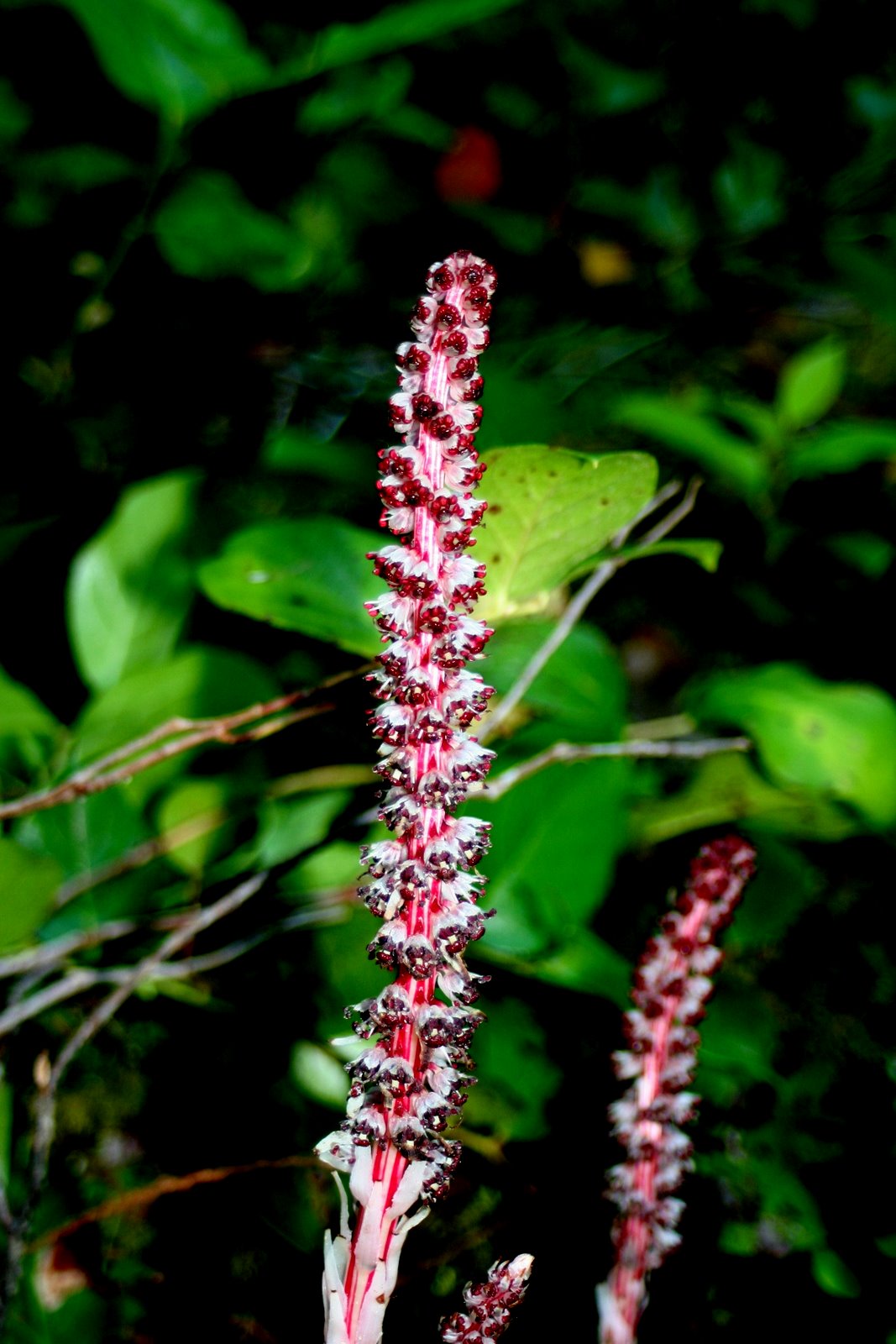
Ozette and Spotted Coralroots

Western Coralroot

Striped Coralroot

Early Coralroot

The only other mycotrophic orchid in the state of Washington is the most beautiful of them all, the Phantom Orchid, Cephalanthera austiniae, named for its bone white color and for the fact that it appears phantom-like on dark forest floors where nothing else seems to be growing.


Other mycotrophs, though not orchids, have a bizarre beauty of their own.  Most, like the Indian Pipes and Vancouver Groundcones, are smaller plants, but some like the pine drops can grow to several feet.  Finding them is always an unexpected delight.

Indian Pipes

Vancouver Groundcones

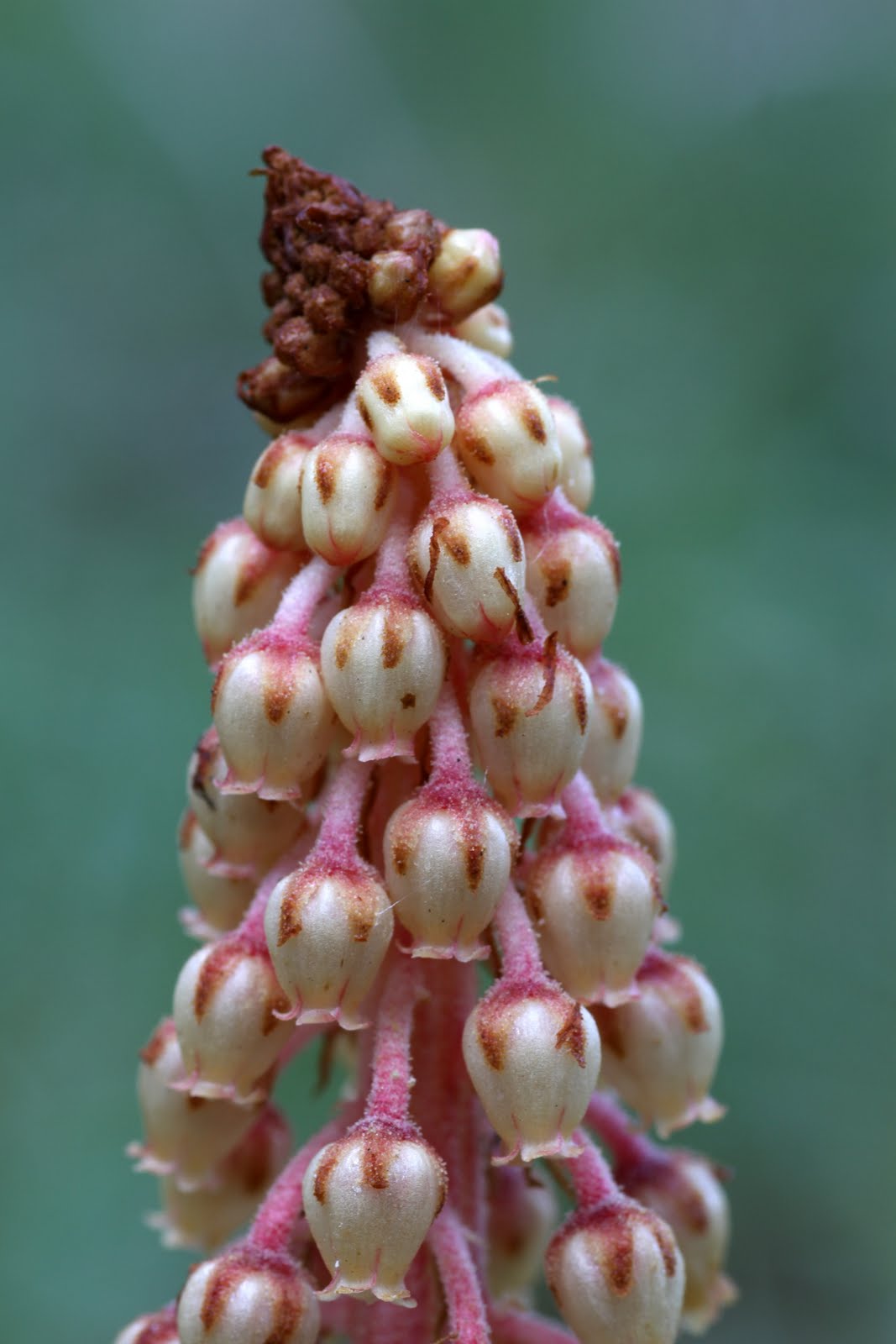
Pinesap

Candystick

Pinedrops

Gnome Plan


Wednesday, October 12, 2011

Three Orchids on the Goat Mountain Trail


I am way behind in blog posts, but I guess that gives me something to do over the winter months when there's not much hiking to be done.  This post, then, goes back to the beginning of August, August 5th, to be exact.  That afternoon for a few hours a friend and I went to do some hiking on the Goat Mountain trail in Mount Baker-Snoqualmie National Forest.

We did not go far enough on the trail - did not have enough time - to get out of the trees and into areas where we could view and photograph the surrounding mountains.  We did see some interesting plants and wildflowers, however, and that is going to be the main subject of this post, though the light was not very good and photography was difficult.


The plants we saw, all under rather heavy forest cover, were primarily saprophytes.  That name is no longer in common use as a result of further research on these plants, but I cannot remember what they are now called. These are plants without chlorophyll, leafless, and living off decayed matter in the soil through a sympiotic relationship with soil fungi.


One of these plants that seemed to be everywhere was Monotropa uniflora, Indian Pipes, also known as the Ghost Plant or Corpse Plant for obvious reasons.  We also saw two saprophytic orchids, both Coralroots, though one of them was finished blooming.  They were the Spotted Coralroot, Corallorhiza maculata var. maculata and the Early Coralroot, Corallorhiza trifida.


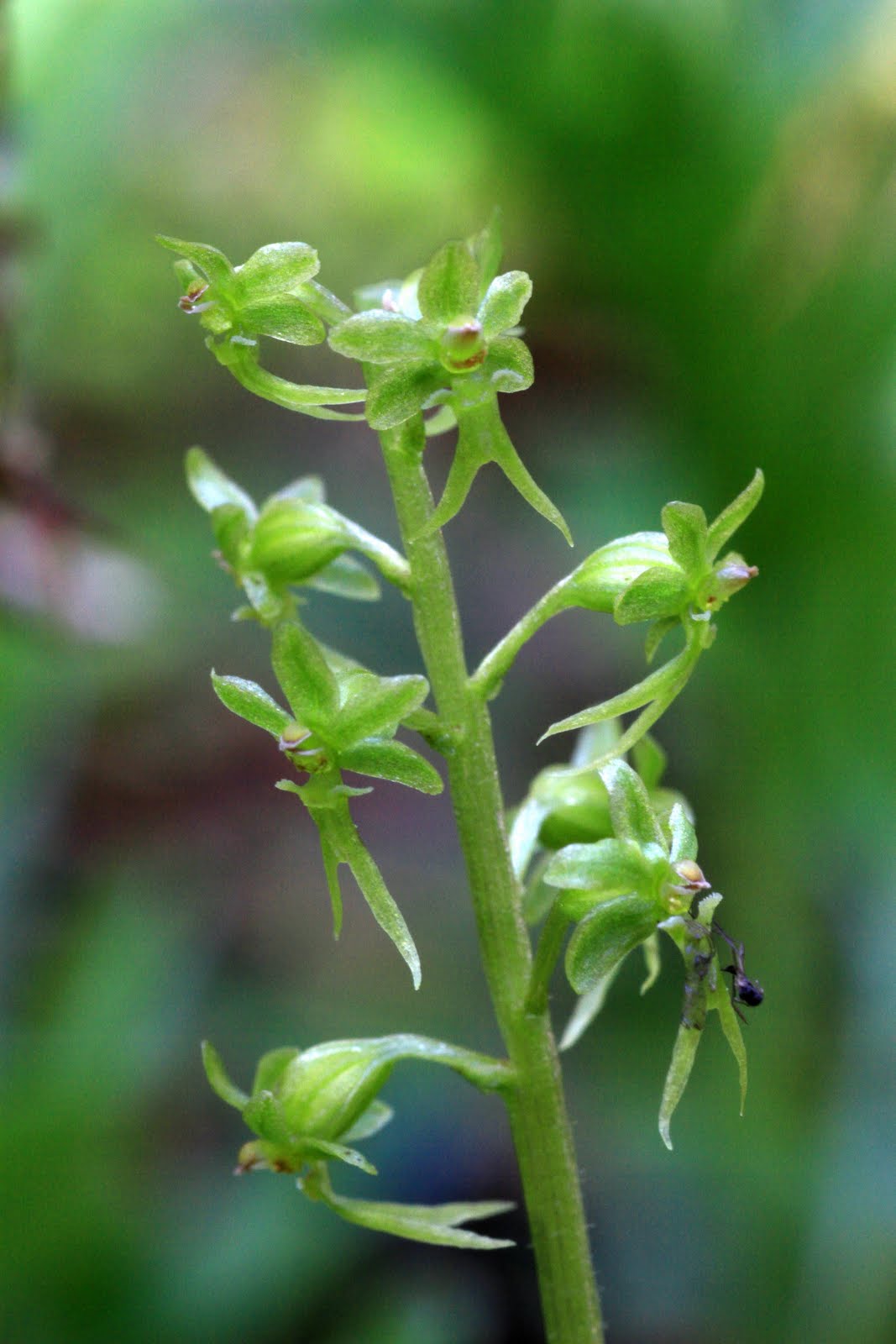
The Early Coralroot was finished blooming, but there were many nice clumps of them that we will have to go back and see next year when they are still blooming.  We did see one other orchid in bloom that is not a saprophyte, however, the everywhere present Listera banksiana, the Northern Twayblade.  I did not get the best pictures of it, so this will have to do.


One other plant, blooming everywhere, especially in damper areas, was the Long-tailed Ginger, Asarum caudatum.  Unless you are looking for it or know what you are seeing, its flowers are not usually noticed since they lie on the ground under the leaves.  Seeing them is always a treat since their color, long tails and unique shape are unmatched.

Monday, May 9, 2011

The Chuckanuts

We have had the coldest April on record since the 1800's and twice our normal amount of rainfall - April was not a great month and May has not been much better so far.  Today was chilly and cloudy, at least in the morning, but I did manage to get out for a little while.  Went to the Chuckanuts, the low mountain range, south of Bellingham and the only place where the North Cascades come down to meet the sea.

There wasn't a lot blooming, the tide was in at the beaches and there wasn't a lot to see there, but I did check out a few spots.  Went to see how the Corallorhiza striata were doing along the Interurban Trail.  From there walked to Clayton Beach in Larrabee State Park and found the tide in.  Drove finally to the south end of Chuckanut Drive and took some time exposures of a cascade on the creek there.

First, the Corallorhizas, which were just starting to bloom.  For those who do not know, these are leafless, saprophytic orchids that get their nourishment from decaying organic material and not through the process of photosynthesis.  There is an area along the Interurban Trail where these grown in some profusion, an area I know through my good friend Marti Anderson.


From the area where the Corallorhizas were found I drove to the parking lot for Clayton Beach and walked to the beach, but was disappointed to find the tide in (note to self: check the tide table next time).  The only picture I too was of the flowers of the Salmonberry, about the only thing in bloom.  Saw no insects or butterflies, though they are usually to be seen along that trail.


Finished there I drove to the parking lot of the Oyster Creek Inn and scrambled down to the creek to get some time exposures of the cascade that comes down the hill and then under a bridge on the drive and past the restaurant.  Not the most exciting day, but at least I was able to get out for a little while and get the few pictures that I've posted here.


Tuesday, July 13, 2010

Backpacking in the Canadian Rockies (2)

Day Two - July 6, 2010

Mount Robson, Berg Glacier and Berg Lake

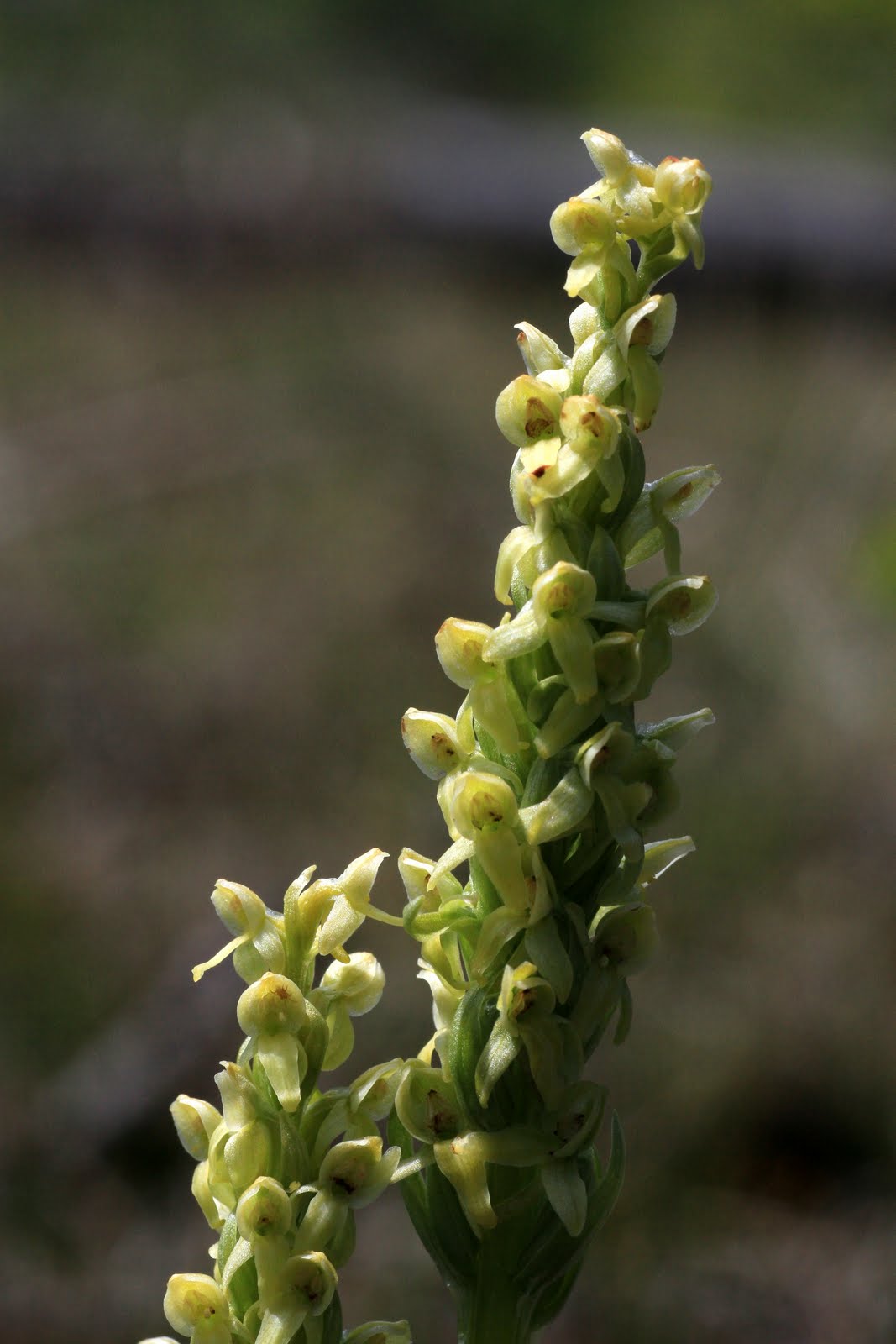
Tiredness is a good sedative and we slept well and warm in our camp at Whitehorn, though the night was cool. I woke about 5:00 am and got up to take a few pictures of some of the wildflowers near the camp including the Green Bog Orchis, Platanthera huronensis, with the dew still on it.  I believe the insect in this photo is a tick, though we had no trouble with them.


Also photographed a carnivorous plant, the Common Butterwort, Pinguicula vulgaris, which grows in abundance along the river at Whitehorn.  This interesting plant has thickened leaves covered with tiny, sticky hairs that trap and digest small insects.  In the picture some of the remains of these insects can be seen on the leaves.


Nearby, blooming and covered with dew, were a lovely flower that I believe to be the Western False Asphodel, Tolfieldia glutinosa, and the Bog Wintergreen, Pyrola asarifolia.  If anyone can correct these identifications, please do so.


After a breakfast of granola with dried blueberries we were on the trail before 6:30 am with the most difficult part of the hike, the four kilometer climb up Emperor Hill, ahead of us.  The first part of the trail is narrow, steep, covered with loose stone, and takes one up the side of the steep south face of the hill.  Very soon we could look back and see the Whitehorn basin far below us.


The trail, still steep, then switchbacked through the woods and brought us out on the cliffs above the Falls of the Pool, then back into woods and finally out to the cliffs across from Emperor Falls.  From there the trail followed a series of switchbacks through the woods to a very steep area where steps had been built.


Near the steps we found two more orchids, several stems of the Early Coralroot, Corallorhiza trifida, a very small leafless and saprophytic plant, and the tiny Northern Twayblade, Listera borealis.  We stopped for quite some time to get photos of these plants.


Not far beyond the steps there was a side trail to Emperor Falls, and with Mount Robson now in sight, we divested ourselves of our packs, leaving them at the side of the trail and taking only our cameras, went to see this impressive torrent.  The spray from the falls made picture taking quite difficult, however.

Emperor Falls and Mount Robson

Photographs taken, we pushed on and soon came back to the Robson River and to the Emperor Campground along the river, the most difficult part of the hike behind us.  We had planned to stop at the campground for lunch, but decided instead to hike on.


Following the river, we finally came to the flood plain below Berg Lake which still lay out of sight.  We hiked a talus slope above the floodplain and finally descended to the flood plain itself and hiked across it to the south edge of Berg Lake.  There we rested a while and watched a ground squirrel going about his thieving business.


Wall Mountain and Berg Glacier


Through the woods again, the trail took us a couple of kilometers along the west side of Berg Lake to our final destination, the Berg Lake campground, where we arrived at about 11:00 am.  We quickly found a campsite and set up our tent, bringing our food and other such items to the shelter there.


After getting everything arranged, pumping water, and soaking our feet, we made lunch, freeze dried eggs which we cooked with some morels we had found in the woods.  Even with the morels they were awful, so we tried slathering them with packets of hot sauce, but they still looked and tasted like yellow styrofoam, only now styrofoam with hot sauce.


After lunch we rested and relaxed a bit, and then, while Nancy was reading, I went back down the trail to get pictures of some of the wildflowers we had seen but not photographed and then further up the trail past the camp to see and photograph some of the wildflowers there.

Indian Paintbrush and Heartleaf Arnica

Red Columbine

Golden Columbine

 I took pictures of two orchids, the Heart-leaved Twayblade, which I found in both its green and red forms and the Green Bog Orchis which was growing in wet areas above the lake.  Also managed to get pictures of a small butterfly which I have not identified.


The day had turned warm and sunny and Mount Robson with its glaciers was spectacular.  They say that Robson is visible only seven days of the year.  If that is true we saw four of those days, since the weather continued warm and sunny the rest of the week.


After our evening meal - freeze-dried Pad Thai and Kathmandu Curry, both very good - we hiked up a trail just north of the camp to Toboggan Falls and to some spectacular evening views of Robson and Berg Glacier.  This trail is very steep but worth the climb.


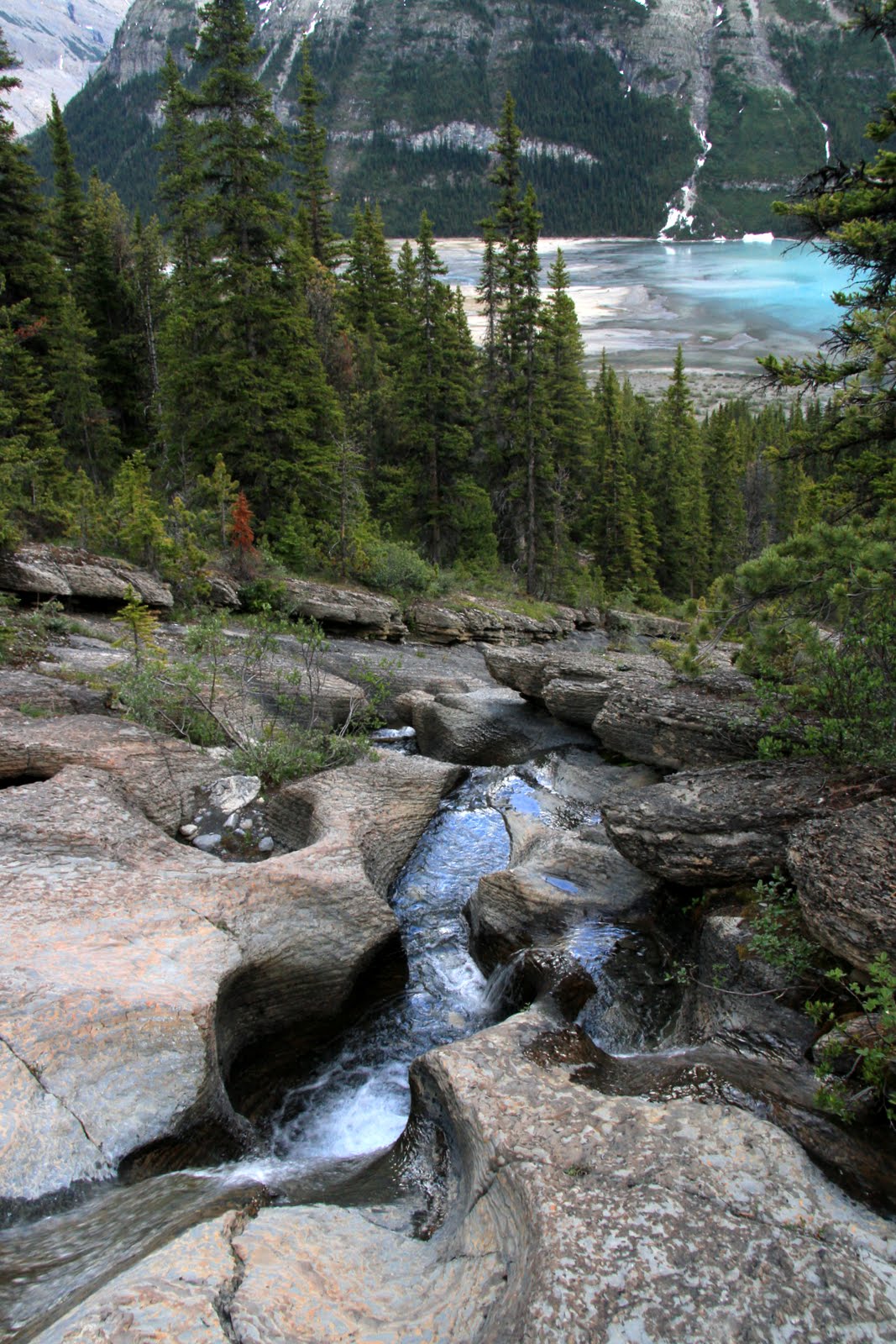
Toboggan Falls is aptly named since the water of the creek for which the Falls are named, "toboggans" down a 45 degree slope, often running in narrow crevices worn into the rock.  The light was fading quickly and it was not easy to get decent pictures.


After taking more pictures near the camp of the lake with its icebergs, of Mount Robson and Berg Glacier, we returned to the shelter, but found it hot, noisy and crowded, so went to our tent instead where we read a while before turning in for an early night.


Note: Six of these pictures were taken by my wife.