
We left about 3:30 am and followed Interstate 90 through Snoqualmie Pass to an area just to the southwest of Ellensburg, Washington. We had gotten the idea of going there from our friend, Marti, whose description of her own recent hike there had piqued our interest: http://meanderingwa.blogspot.com/2010/05/cage-match-tweedy-vs-bitterroot.html.
Leaving the Interstate we drove south a few miles until we came to Manastash Ridge and found the parking area for the Ridge Trail, also known as Ray Westberg Trail. We arrived at 7:00 am and it was immediately obvious that this was a popular hike. Even though it was a weekday and early in the morning, there were quite a few cars parked at the trailhead and quite a few people on the trail.
 On the road to the trailhead we saw a number of California Quail, but unfortunately it seemed that by the time we got the car stopped to take pictures they were gone. This picture is the best I could get and I've posted it in small size since it is a bit out of focus. There were several Turkey Vultures along the way as well and my wife took some shots of them. After getting our camera gear ready to go (for me that's my camera, a bag with extra lens, filters, etc., and a tripod) and loading a day pack with water bottles, trail mix, wildflower books, binoculars, and a few other necessities, we started up the trail.Not far from the trailhead one has the option of taking the Ray Westberg Trail or the Boyscout Trail. These two trails join up again near the top of the ridge and we opted to take the Westberg Trail up and the Boyscout Trail down.
The Ray Westberg trail is pretty much out in the open, rather dry, sagebrush country, with Ponderosa Pine scattered along the way. Some areas were open and some overgrown with scrubby, thorny growth, but the whole first part of the hike was in the sun and I suffered a light case of sunburn as a result. It was a good things we started early and took advantage of the cooler morning temperatures.
Young Ponderosa Pine Cones

Lupine

Balsamroot and Lupine

The area is a wildflower paradise in the spring and we saw more wildflowers than we could remember or photograph, but it took us five hours to do three miles, an indication of how much time we spent identifying, photographing and enjoying them.
White Campion

Jack-Go-to-Bed-at-Noon (Yellow Salsify)

Harsh and Thompson's Paintbrush


Slender Woodland Star and Upland Larkspur

Large Flowered Brodiaea


Some of the more interesting wildflowers were the Tapertip Onion (Allium acuminatum), Western Blue Iris (Iris missouriensis), Bugloss Fiddleneck (Amsinckia lycopsoides), Large-flowered Collomia (Collomia grandiflora), Upland Larkspur (Delphinium nuttalianum), Gairdner's Penstemon (Penstemon gairdneri), Rydberg's Penstemon (Penstemon rydbergii), Cushion Phlox (Phlox hoodii), Cushion Buckwheat (Eriogonum ovatifolium), Modoc Hawksbeard (Crepis modocensis) and Prairie Smoke (Geum trifolium).
Tapertip Onion

Western Blue Iris and Bugloss Fiddleneck


Large-flowered Collomia

Upland Larkspur

Gairdner's Penstemon

Rydberg's Penstemon


Cushion Phlox

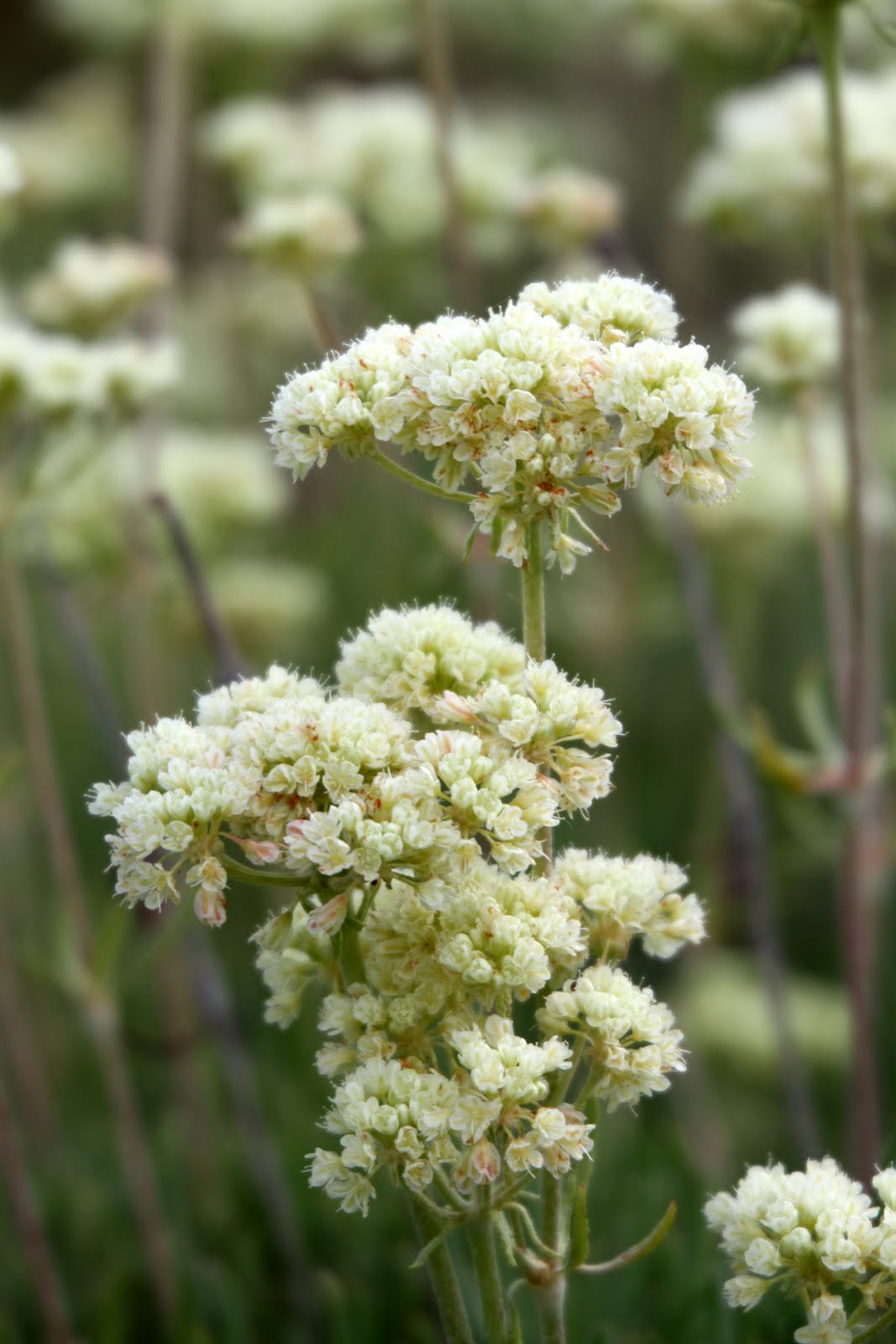
Cushion buckwheat

Modoc Hawksbeard

Prairie Smoke

We followed an open sunny gully to the ridge and then followed the ridge to the top where there is a memorial to Ray Westburg and a road that leads to the University of Washington's observatory. It was along the ridge that we found what we had come to see, the Bitterroot (Lewisia rediviva). We had seen this incredible plant in nurseries but never in the wild. It flowers with no apparent leaves in rocky soil, the buds and then the flowers lying prostrate on the ground. We found it first in rocky areas along the edge of the ridge and then in abundance near the road at the top of the ridge.


The name "rediviva" (restored to life) apparently refers to the fact that it goes dormant after flowering and then reappears like magic in the spring. We found it ranging in color from white to deep pink and spent nearly an hour taking photos of it at the top.


At the top of the ridge is a memorial to Ray Westberg, a popular English teacher and wrestling coach at Ellensburg High School, and a former Vietnam veteran. There are great views of the surrounding countryside and endless wildflowers there also.


Western Tanager

 We found other things to photograph, a beautiful metallic green beetle and several birds, the Western Meadowlark, a Western Tanager, and a Black-headed Grosbeak. Photographing birds is a new venture for me and I really need a longer lens to take good pictures, but at least we have the memories of these beautiful birds.
 After taking pictures we headed down, catching the Boyscout trail a bit below the top near a large Ponderosa Pine and finding it shaded, cool and relaxing after the hot early afternoon sun on the ridge. Coming out of the gully through which that trail winds we had a short walk along an irrigation canal to our car.
That was not the end of our adventures for the day, however. We decided to drive up the Reecer Canyon Road west of Ellensburg to Lion Rock. At our first stop, now away from civilization, we turned off the car and engaged the parking brake to take pictures of some Davidson's penstemon (Penstemon davidsonii) and the valley below.
When we returned to the car we found that we could not disengage the parking brake. Fortunately our cell phone had coverage and we were able to call a towtruck. Several hours later, after an expensive tow back to Ellensburg and some minor repairs (the brake cable had broken), we were on our way once again and drove north from Ellensburg to Leavenworth through Blewett Pass.
From Leavenworth we drove north to Plain, where we knew of a clump of Phantom Orchids, but they were not in bloom yet, so we drove back to Leavenworth where we had our evening meal and spent the night. We had been unsure of whether or not camping would be available, so did not take our backpacking equipment or tents. Instead, we parked our van in a convenient location (a Safeway parking lot), put up the curtains and spread our pads and sleeping bags in the back and slept away the night in preparation for another hike the next day. Apart from the car trouble it was a good day.


